
Sterling Heights Previous Residents Sources
The right source depends on the era. Today’s parcel gives a fixed starting point, while the deed index connects ownership transfers. Township assessments, regional directories, newspaper microfilm, and census schedules add a historical household layer. The table separates what the sources actually cover from what they merely suggest. A person listed in a directory, for example, is a dated address lead rather than a present-residency claim.
| Source | Years it covers | Where held | What it shows |
|---|---|---|---|
| Register of Deeds | Online depth not stated; older-category warning before December 1955 | Macomb ROD online and public terminals | Grantor, grantee, date, instrument, legal description, copy path |
| Sterling Township assessments | 1899-1968 | Archives of Michigan RG2023-99 | Pre-city taxpayer and property clues |
| Sterling Heights assessments | 1969-1979 and 1970-1979 groups | Archives of Michigan record groups | Early city assessment history |
| Mount Clemens directory index | 1896-1966 | Mount Clemens Library | Regional name and address leads |
| Utica Sentinel microfilm | 1860 to approximately 1960 | Sterling library and Heritage Alliance lead | Notices, obituaries, business, and community references |
| Edgerton Cemetery table | Historic interments; dates vary | City of Sterling Heights | Surname, given name, date, and age |
Federal census schedules become public under the 72-year release rule. They can help place a household in its township or ward setting, but the address, family composition, and legal description still need to be compared with the local trail.
Sterling Heights Past Residents Parcel
Before tracing past residents, record the current parcel carefully. Save the property card and GIS identification with the current owner, mailing address, situs address, tax ID, subdivision, lot or block, legal description, and any public sale-history link. The owner mailing address is not the same thing as the property location. The legal description is especially important because a modern street number can change after a parcel split, condominium conversion, subdivision, or new municipal label.
Macomb GIS accepts property address and full or partial tax ID searches. The Search All Known Address feature searches E911 points and can include unit addresses attached to one tax parcel. Use it to find the correct property record, then keep the parcel ID beside every subsequent deed and historical source. A modern ZIP alone is not a sufficient bridge to an older record.
Note: A current parcel card anchors the research trail, but it does not identify every person associated with the address.
Sterling Heights Past Residents Deeds
The deed chain is the core ownership trail for previous residents. Search the current owner as a grantee, meaning the buyer or recipient, around the likely acquisition period. On a matching record, capture the seller or grantor, recording date, document number or book and page, legal description, instrument type, and related-document links. Then search that seller as a grantee in an earlier period. Continue only after comparing the legal description at each link.
- Use Sterling Heights Assessing or BS&A to copy the current parcel and legal description.
- Run the current owner as grantee in the Macomb Register of Deeds Basic or Advanced search.
- Open the likely acquisition record and record the grantor, date, document identifier, and legal description.
- Search that grantor as an earlier grantee, using a date range and the legal description to distinguish similarly named parties.
- Repeat the transfer sequence. Treat mortgages, releases, assignments, and liens as document events, not ownership transfers.
The county’s Basic index is free. Advanced subscriptions, image or copy purchases, staff searches, and mail requests are separate routes. Public terminals at 120 N Main are free for index viewing. A written request should give the document type, party names, approximate date, and the address or legal description; staff searches are listed at $5 plus $1 per page.
Macomb Register of Deeds search options shows the Basic and Advanced document-search choices used in this historical-address process.
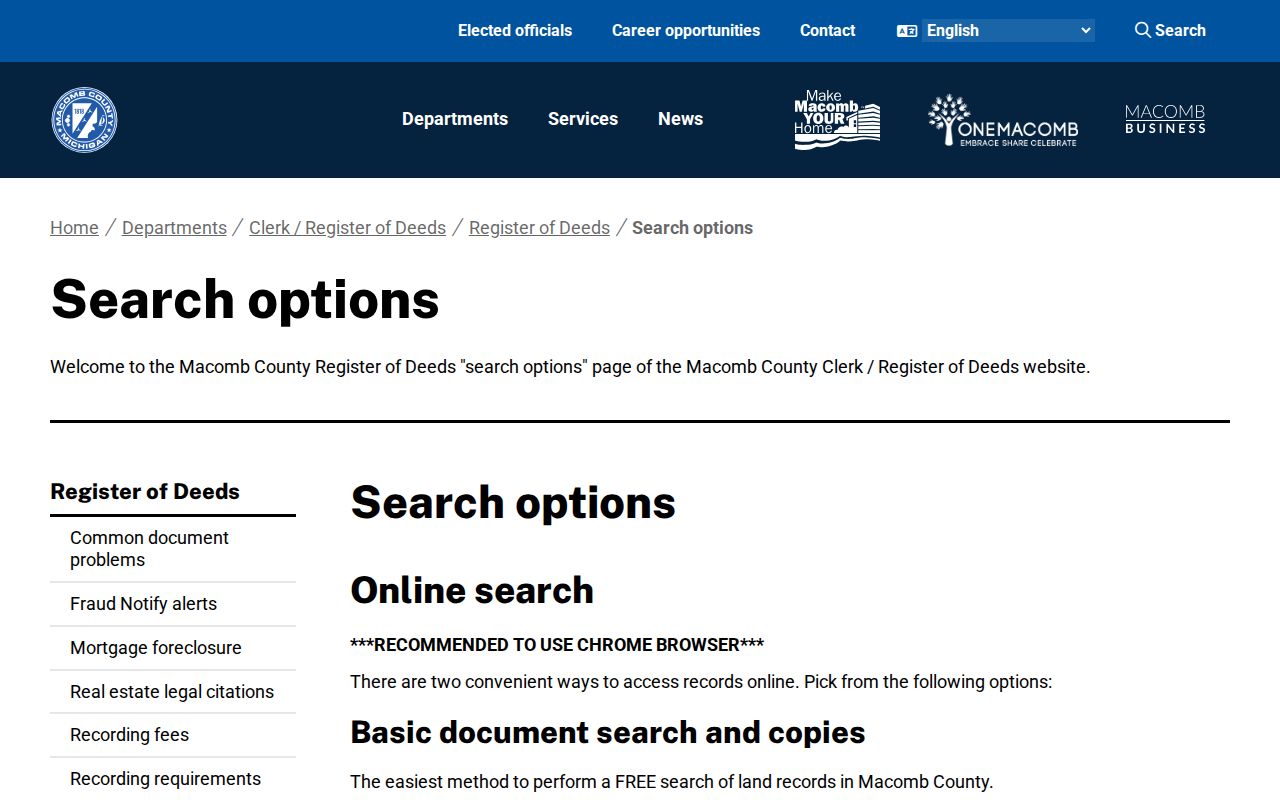
The free index is a useful first pass. A clear image or a certified copy follows a different access path, and a public-terminal or written-request fallback remains available when the online trail is thin.
Sterling Heights Previous Residents Terms
These terms keep an address history from becoming a name-only search. Copy them from the actual record, including its spelling and punctuation.
- Grantor
- The party transferring an interest in a recorded deed, usually the seller in a purchase.
- Grantee
- The party receiving the interest, usually the buyer. Searching a grantee backward can reveal an earlier purchase.
- Chain of title
- The sequence of recorded ownership transfers for the same property. It must be tested by legal description, not a surname alone.
- Legal description
- Lot, block, subdivision, or metes-and-bounds language that identifies land in deeds and plats.
A document result can include grantor and grantee names, instrument type, recording information, legal description, related documents, and an image path. Images can be degraded, and the county notes that its index may be incomplete or still under verification.
Sterling Heights Previous Residents Records
Records before December 1955 may be under Deed or an older title category, according to the county’s search guidance. The Register of Deeds does not publish one clean online cutoff date, and its grantor-grantee index may not be fully indexed or verified. Search the name, legal description, and parcel or address when available. Do not assume an older document was indexed under the current street number.
When online results stop, use the free public terminal, purchase the relevant copy, ask staff for a focused search, or submit a written request. The county asks for details that make the item findable, including parties, approximate year, document type, address or legal description, and, for some lien-related work, recording information. More than 15 copied pages can be available the next business day after noon.
Note: The pre-December-1955 warning directs a broader search method; it does not prove that every older record is unavailable online.
Sterling Heights Past Residents Era
Sterling Heights incorporated as a city in 1968. A past-residents trail from an earlier decade may therefore be filed under Sterling Township, a rural route, Utica, or another postal label. The Archives of Michigan holds Sterling Township assessment records for 1899-1968 and Sterling Heights assessment groups for 1969-1979 and 1970-1979. Those overlapping custody layers are a geography fact, not conflicting evidence.
Use the legal description, plat book, township name, and directory year together. The Heritage Alliance identifies a 1956 plat book, early-1900s maps, and Sterling Township documents available through back adult services. This is the useful geographic bridge when a current parcel has no obvious match under a former address label.
Sterling Heights Previous Residents Library
Sterling Public Library’s research resources connect local-history materials, newspapers, Ancestry Library Edition, MyHeritage Library Edition, and the digital archive. Its local-history collection includes photos, maps, documents, clipping files, oral histories, and township material. Mount Clemens Library is the regional fallback for directory, obituary, funeral, probate, cemetery, court, military, naturalization, and yearbook index work. Ask the librarian to confirm whether a particular directory volume has a reverse section or abbreviation key.
The Mount Clemens City Directory Master Index covers 1896-1966, but it is a regional index, not a verified complete Sterling Heights directory run. The published research did not locate an exact Sterling Heights Sanborn set. A 1909, 16-sheet Mount Clemens Sanborn collection is nearby county context only and must not be read as a Sterling address map. The library’s local archive and newspaper collections offer better supporting leads for a Sterling parcel.
The Macomb County Heritage Alliance resources page identifies the regional microfilm and Sterling collection leads.
Utica Sentinel microfilm, approximately 1860-1960, can supply notices and community references. Pair a newspaper clue with a date, parcel, directory, or deed before treating it as an address connection.
Sterling Heights Past Residents Endpoints
Directories, census schedules, notices, obituaries, probate records, and cemetery entries can help close an older household trail. Pair a directory year with the appropriate public census release, then compare spelling variants, spouse or relative names, township labels, and address wording. An obituary can name family links, while a probate file can add estate context. None should replace the legal-description test in the deed sequence.
Edgerton Cemetery’s public burial table lists surname, given name, dates, and age for historic interments.
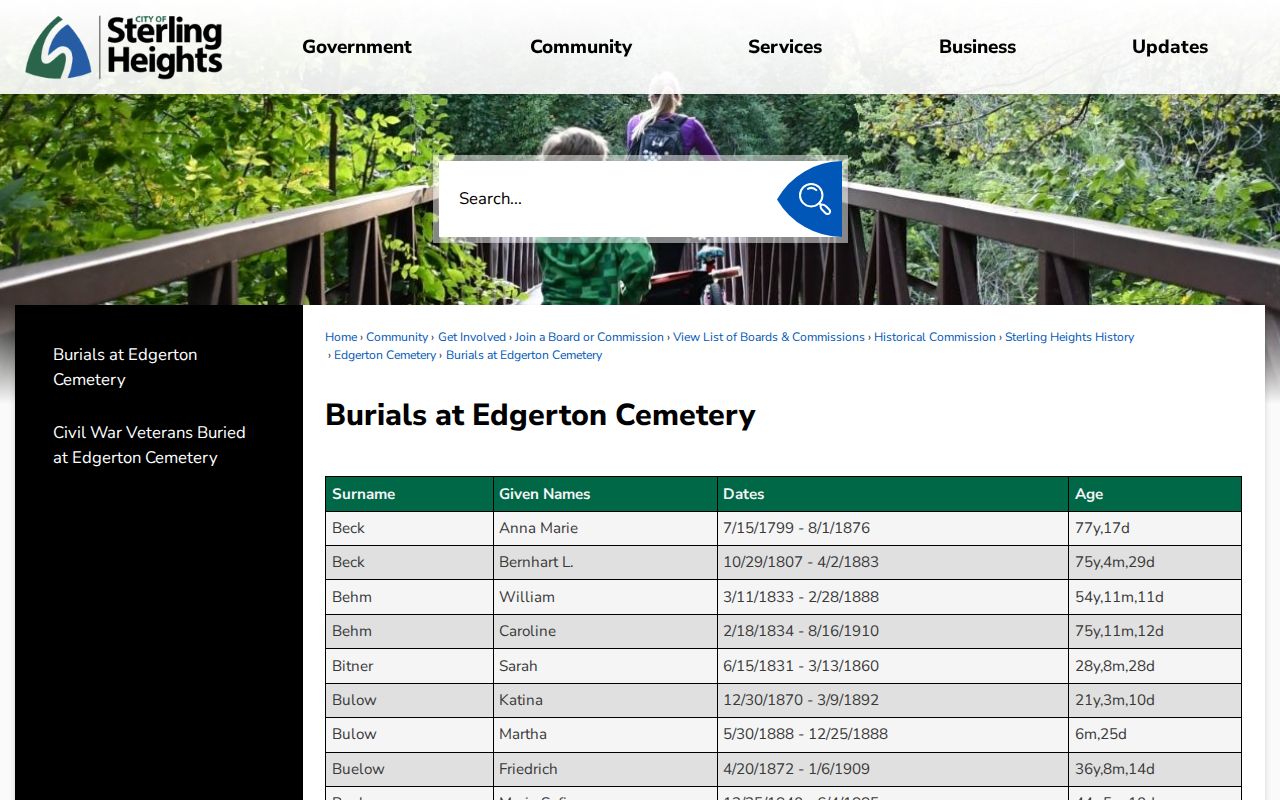
An interment is a family-history endpoint, not a complete biography or a complete residence history. The Sterling oral-history project adds a separate human record: it began in 1985, recorded 100 interviews, transcribed 70, and placed 29 in a published volume.
For help reading the historic volumes themselves, the Sterling Heights Directory Book keeps the directory-collection focus separate from a single-address trail.
Limits of Previous Residents
Previous residents research can document a dated ownership or address lead. It cannot produce a guaranteed list of all past occupants. Some records were never indexed by address, and protected addresses, sealed files, utility customer data, and private organization membership are not public household sources. A current owner, seller, permit applicant, or newspaper subject may also be connected to an address without living there.
Lawful use. Use Sterling Heights house-history records for personal, family-history, heir, or civic research. Do not use an older address trail to stalk, harass, intimidate, or harm any living person.
Record uncertainty plainly. A durable history labels each item as a deed, assessment, map, index, directory, obituary, cemetery result, or archival lead rather than collapsing them into one claim about past residents.