
Finding Sterling Heights Residents Through Records
No official list captures every person in Sterling Heights. A useful search starts with the record tied to the question. An owner name or address belongs first in the property system. A document party belongs in the deed index. A public voter match, court party, or old newspaper item can confirm a different part of the story. Those are separate facts, not a single answer about a whole household.
Use more than one match before drawing a conclusion. The owner mailing address may be elsewhere. A voter result reflects registration, and a court filing identifies a party, not a current address. Library sources are especially useful when the name or place predates the modern city. The process below keeps each source in its proper role.
- Search the City of Sterling Heights assessing service by address, owner name, or parcel number.
- Open the parcel in Macomb GIS and record its tax ID, situs address, and legal geography.
- Check the Macomb Register of Deeds index for grantor and grantee names tied to the parcel.
- Use the Michigan voter service only for the public registration result it returns.
- For an older household, ask the library for newspaper, directory, map, or township-era material.
Sterling Heights Residents Records Offices
Sterling Heights, Macomb County, and Michigan keep different parts of a resident record trail. The city assessor connects a parcel to current assessment data. The Register of Deeds records instruments affecting land. State voter and court services may provide a public confirmation route. When an online screen does not hold the needed record, the custodian, counter, written request, or library is the next channel.
Macomb County Register of Deeds
120 N Main
Mount Clemens, MI 48043
586-469-7953
Sterling Heights Assessing
40555 Utica Road
Sterling Heights, MI 48313
586-446-2340
Michigan Elections Lookup
Statewide registration service
Public status and election geography
Local questions: City Clerk
Sterling Heights Residents and Parcel Search
The city’s Assessing page leads to a public BS&A search. It is the practical first stop for a current parcel question because it accepts address, owner-name, and parcel-number routes. The result family can include assessment and taxable values, an owner mailing address, exemption indicators, building characteristics, and links to related city services. A homestead indicator can support an inquiry about owner occupancy, but it does not identify every person living there.
| BS&A search choice | Use it for | Important limit |
|---|---|---|
| Address | A full address or range, with an advanced option | Use the situs result, not a postal guess |
| Name | Names associated with parcels | Try spelling variants and omit punctuation |
| Parcel number | A known tax identifier | Verify formatting from the returned record |
| Comparable building | Property characteristics | It is not a resident roster |
Sterling Heights Assessing describes the address, parcel, and comparable-building routes shown in this capture.
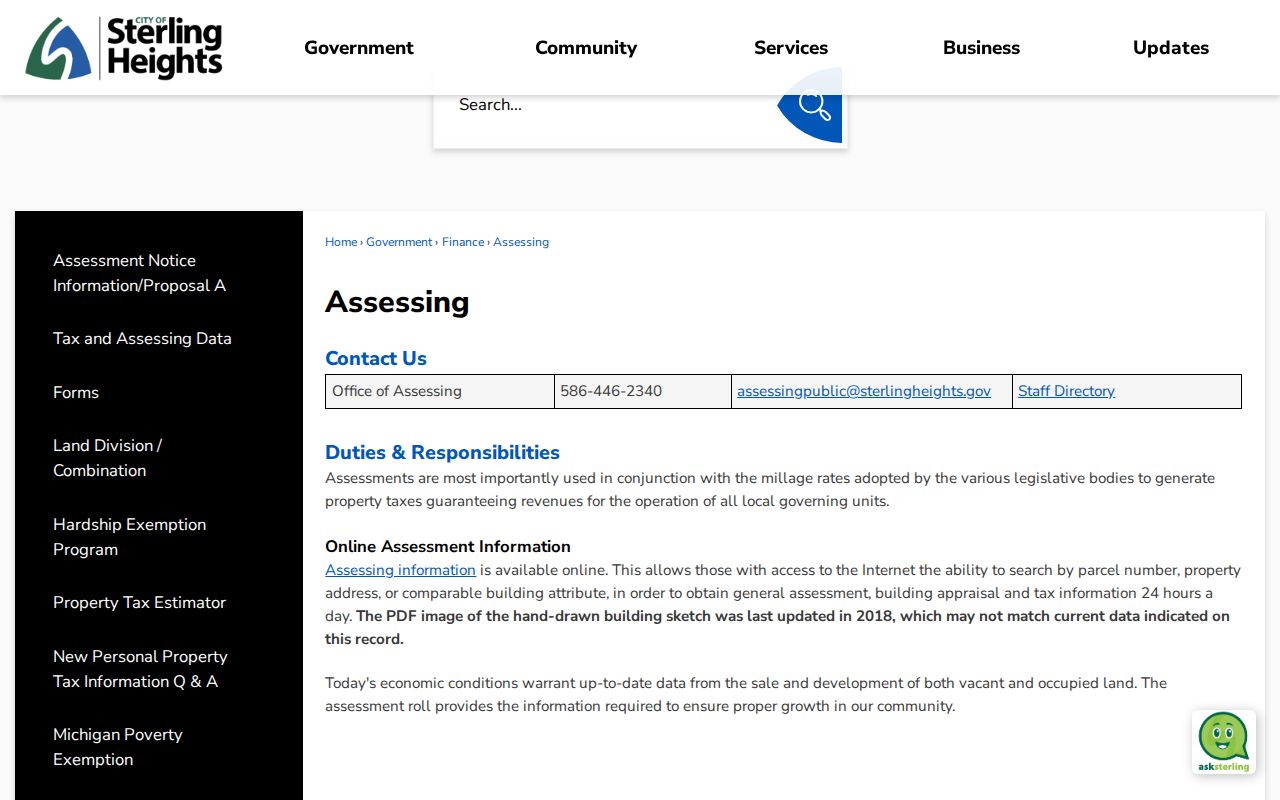
The image shows the official starting point, not proof of a household. The city also warns that a hand-drawn building-sketch PDF was last updated in 2018 and may not match current conditions.
BS&A Online for Sterling Heights presents the municipal service choices that sit behind the property search.
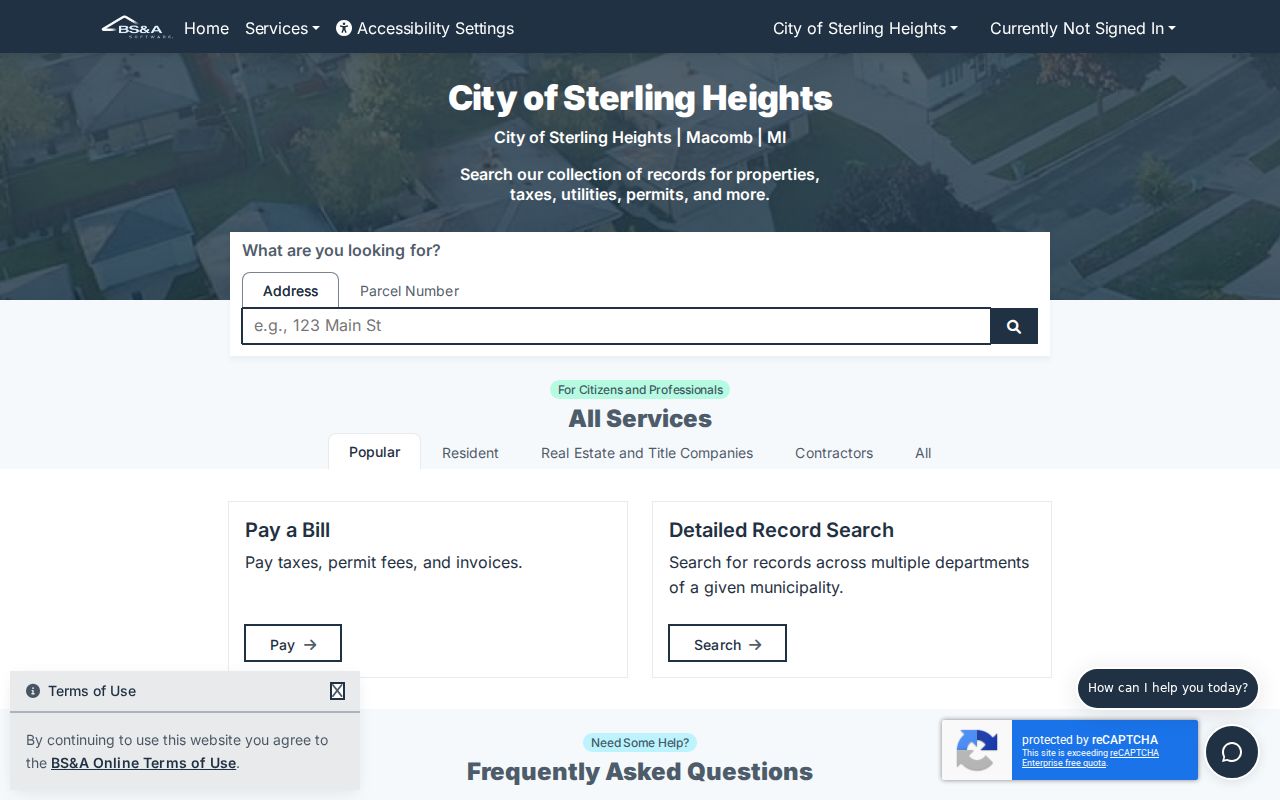
Ordinary property lookup does not require an account. A BS&A account is for claiming a property, not for an initial public-record search.
Map a Sterling Heights Resident Address
Macomb County Parcel Explorer adds the map layer that a parcel card cannot. Search a full or partial tax ID, or a property address. The county’s guide says to omit a street suffix when an address search fails. “Search All Known Address” reaches the E911 address database, which can include apartment, condominium, or mobile-unit address points tied to one tax parcel. That richer address layer still does not turn a parcel into a list of occupants.
Use Identify after panning and zooming to the parcel. Layers, selection, measuring, printing, and export tools help connect a street address to parcel geometry and adjacent land. The city’s OneView map adds ZIP, voting, school, flood, utility, subdivision, road, and zoning context. For a full street-by-street parcel process, use the Sterling Heights street directory.
Macomb GIS provides the parcel map and tool panel shown below.
Map layers supply location and parcel context. They should be checked against the assessor record and, when ownership history matters, the recorded-document index.
Sterling Heights Residents in Voter Records
Michigan voter registration records are public through the state’s access rules, but the public result has clear boundaries. Michigan does not register voters by party. Driver-license and state-ID numbers, month and day of birth, phone numbers, email, the office that first received a registration, and refusal-to-register information are excluded. Protected voters and Address Confidentiality Program participants may have address information withheld.
The interactive service is best used as a current, individual check. A full voter file follows a separate request process, and the public lookup is not a directory of everyone connected to an address. Status also changes as registrations are maintained. Pair a name match with a parcel, date, or another official record before treating it as the same person.
Michigan Voter Information Center is the statewide lookup surface captured here.
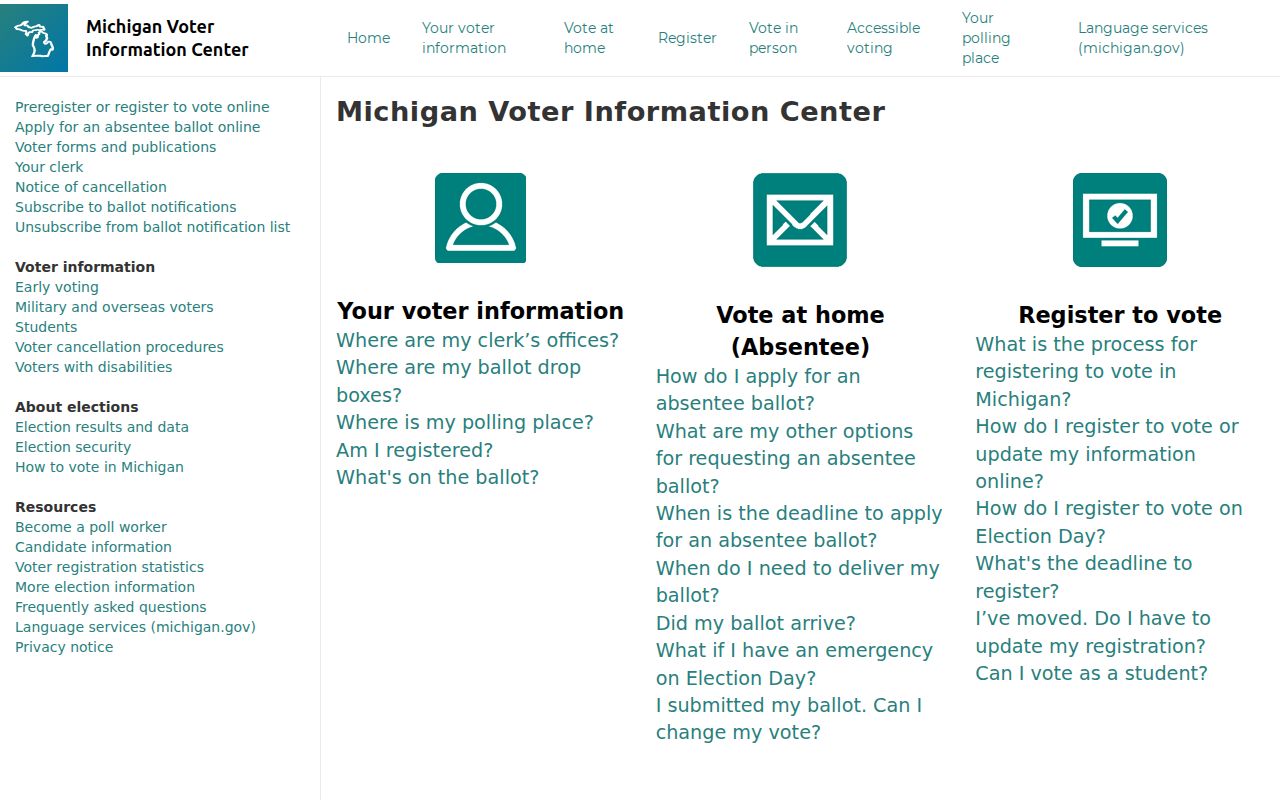
The form is a public registration route. It is not evidence that every person at a Sterling Heights address is registered or visible.
Sterling Heights Residents in Recorded Deeds
The Macomb Register of Deeds search is a party-and-property trail, not a resident list. Free Basic Document Search is a broad first pass. Advanced access supports address, legal-description, parcel-ID, and party searches, while images and copies have separate costs. Search a last name with and without a middle initial, then use a recorded-date range to reduce common-name results. A grantor transfers an interest; a grantee receives one.
| Either party | Broad name search, normally last name followed by a space and first name |
|---|---|
| Grantor or grantee | Transferor or recipient role, useful in a backward deed trail |
| Address or parcel ID | Advanced options for a known property |
| Legal description | Often stronger than a modern address for older land records |
| Document type and dates | Narrow a crowded result set and identify the instrument |
The index may be incomplete or unverified, and the county flags records before December 1955 as a special search problem. Free public terminals can show indexes. Staff search, written, mail, and counter routes remain available when a web search stalls; clear images or copies may require purchase.
Macomb Register of Deeds Search Options distinguishes the basic and advanced routes.
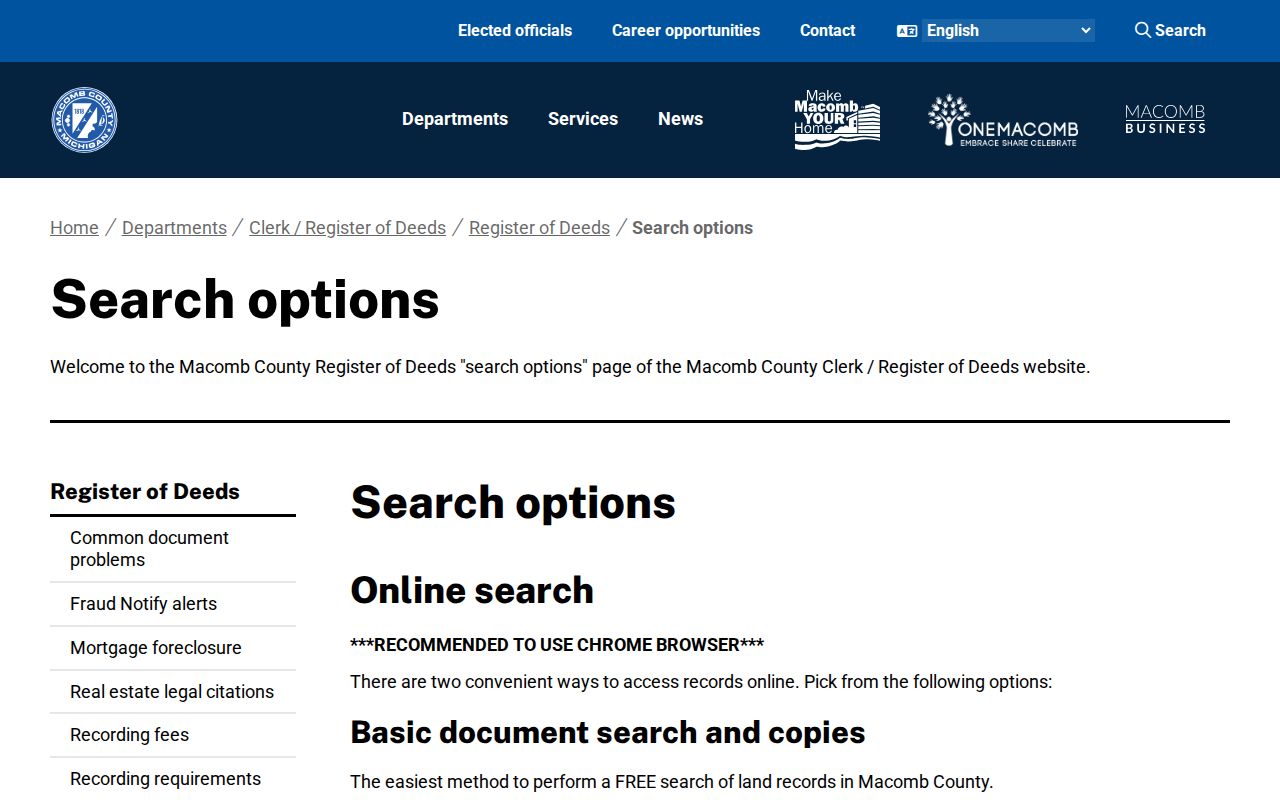
A name in a deed identifies a party to a recorded instrument. Confirm the document type, parcel, legal description, and dates before using it in a Sterling Heights resident trail.
Current Sterling Heights Resident Directories
Current Sterling Heights sources are distributed by function. They can confirm a property connection, an official filing, a registration result, or a case party. None should be read as a complete roster. The fastest route depends on whether the starting fact is a name, parcel, event, or relationship.
| Official source | What it can show | Access route |
|---|---|---|
| City assessing and BS&A | Parcel connection, owner name, situs and mailing fields | Public property search or assessor counter |
| Macomb GIS | Parcel geometry, tax ID, address point and layers | Public map viewer |
| Register of Deeds | Grantor, grantee, instrument, record date, legal description | Basic index, terminal, staff, mail, or copy route |
| Michigan voter service | Public registration match and election geography | Interactive lookup or separate records request |
| Library and archives | Historic names, notices, directories, maps, and local context | Research desk, collection, microfilm, or archive request |
When the goal is to verify one person rather than investigate a location, the Sterling Heights resident lookup uses these sources in a name-centered order.
Sterling Heights Resident Lookup Court and Vital Trail
MiCOURT Case Search provides a statewide public case-search entry point. A court result may show a party name, case number, case type, dates, status, and docket information, but sensitive classes and nonpublic records are excluded. Sterling Heights district matters route through 41-A District Court. The 16th Circuit and Probate Court sit in Mount Clemens, where a party lookup can lead to a public file request. A filing can confirm a party role, not a present residence.
The court landing page below is the first step for a name search. For the official document, use the named court’s file or copy route rather than relying on a display result.
MiCOURT Case Search is shown in this Sterling Heights resident-record capture.
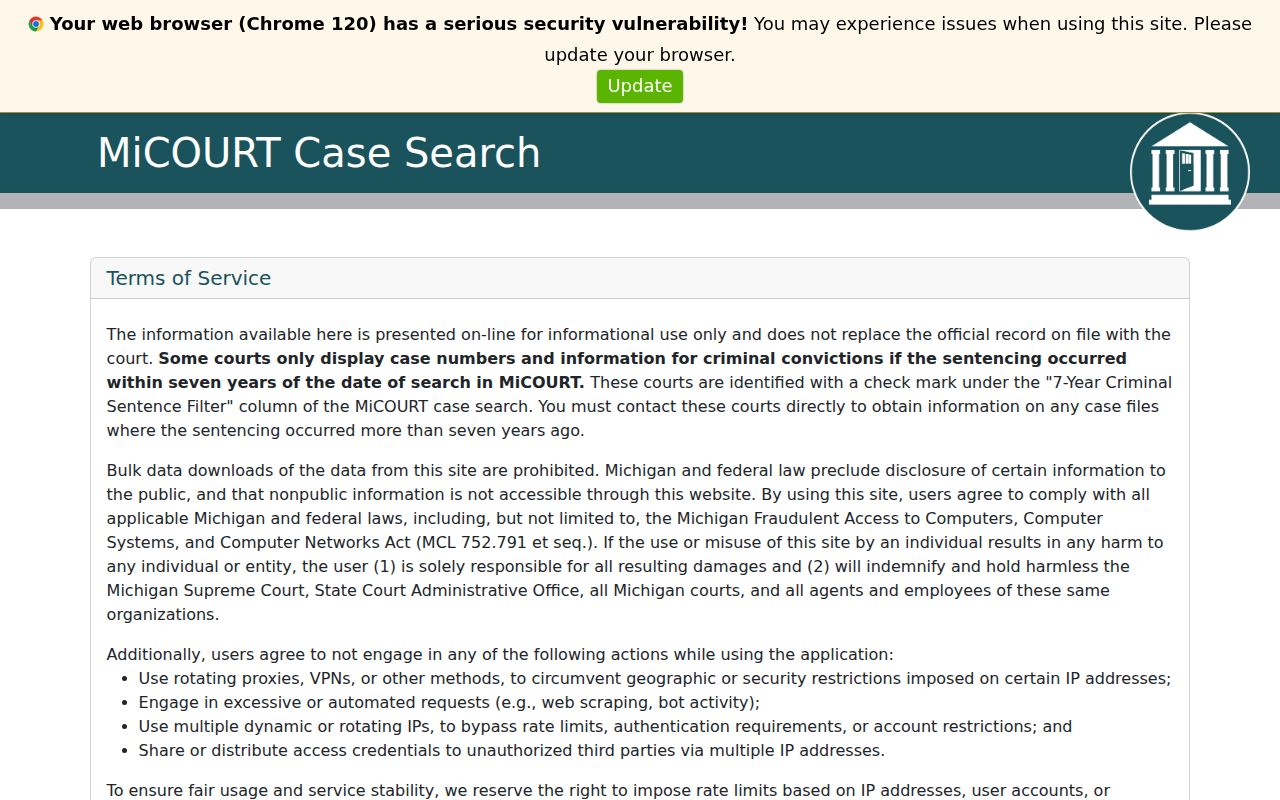
The public portal is informational. Case categories and available fields vary, so a matching name should be checked against dates, court, and case details.
For vital evidence, Michigan Vital Records accepts birth, death, marriage, and divorce order requests. Michigan records date from 1867. Birth records under 100 years have eligibility rules, while death and marriage access follow their own rules. Mail, online, drop-box, appointment, and Will Call routes are documented; Macomb’s Clerk/Register and library resources supply additional local and historical channels.
Michigan Vital Records ordering shows the event, identity, eligibility, delivery, and payment choices.
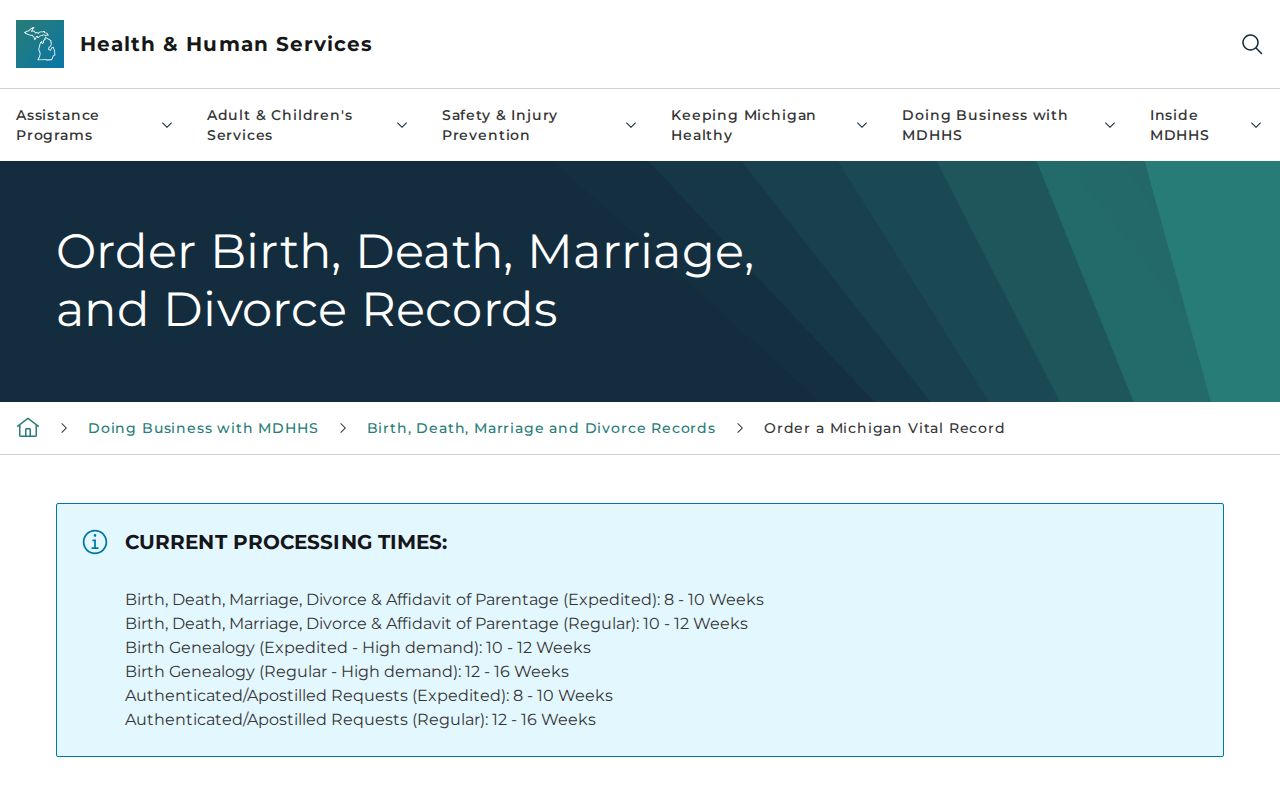
A certificate request requires the right record type and requester information. An index lead and a certified copy are different forms of evidence.
Sterling Heights Resident Records and FOIA Limits
The city’s FOIA route is for existing city records that are described with enough detail. A request may be submitted by email, mail, drop-off, or fax. Michigan Freedom of Information Act, 1976 PA 442, MCL 15.231 et seq., generally calls for a response within five business days, with a possible written ten-business-day extension. It does not require a public body to create a new list or release exempt material.
Michigan public-record access also works alongside record-specific privacy limits. Address Confidentiality Program participants and protected voters may be hidden. Motor-vehicle data, sealed matters, juvenile matters, adoption information, and some vital fields are not unlocked by a broad request. For an error, keep the record number and ask the office that created the record about its correction route.
Sterling Heights FOIA supplies the local request channel captured below.
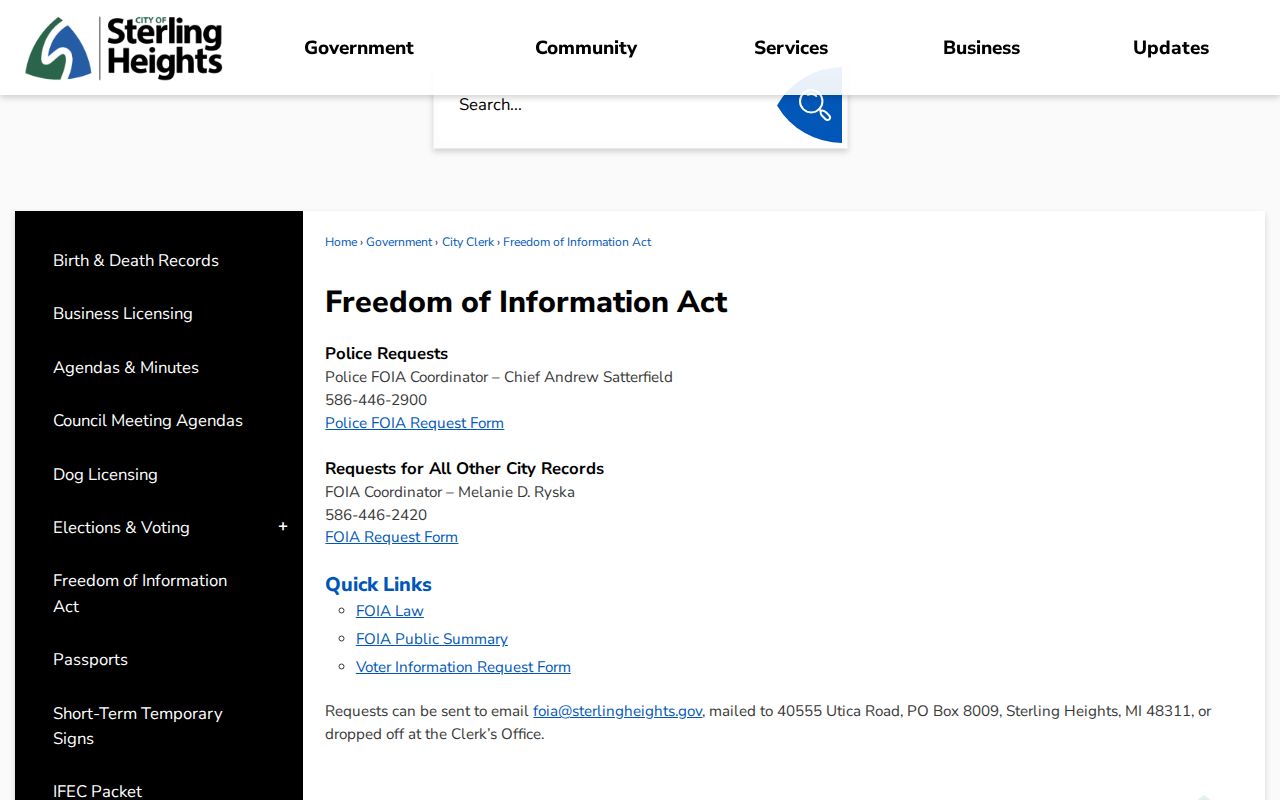
A focused request for an identified record is more workable than a request for an all-purpose resident compilation.
Sterling Heights Resident Records Compared
A direct search at the office that holds a record gives the reader a source, date, and record number that can be checked again. Commercial directory products may combine public and licensed material, but their identity matching, update timing, and opt-out handling can vary. A direct custodian record is still limited by its purpose: a deed follows land, a voter result follows registration, and a court entry follows a case.
| Research route | Strength | Check before relying on it |
|---|---|---|
| Official custodian | Known agency, date, and access channel | Record type, visible fields, and restrictions |
| Library or archive | Historic context and original collection citation | Volume, issue date, and whether an entry is an index lead |
| Commercial directory category | May surface a research lead | Source, freshness, same-name match, and removal process |
Keep a short source log with the link, retrieval date, name spelling, identifier, and the record’s own limits. It makes conflicts visible and gives the next custodian a precise question.
Historical Sterling Heights Resident Directories
A historic search often needs a different place name. Sterling Heights became a city in 1968, so older material may be cataloged under Sterling Township, a rural route, Utica, or a nearby regional collection. The local research record did not establish a complete printed Sterling Heights household-directory run. That gap matters: do not attach an unverified publisher or year range to a family claim.
The strongest regional directory lead is the Mount Clemens City Directory Master Index, covering 1896 through 1966. It may lead to names and addresses in volumes that must be inspected with the library. A historical entry can show a mailing or household snapshot, not a modern address. The full collections and reading method are detailed in the Sterling Heights directory book.
Sterling Heights Residents Before Cityhood
Older records cross the township-to-city boundary. Archives of Michigan holds Sterling Township assessment records from 1899 through 1968, then Sterling Heights assessment groups for 1969 through 1979 and 1970 through 1979. Sterling Township election records cover 1882 through 1910. These dates make the 1968 transition a useful search breakpoint, especially when a present-day street address does not appear in an older index.
- Parcel
- A tax and land identifier that links an address to assessment and map records.
- Index
- A finding aid that points to a record; it is not automatically the underlying document.
- Criss-cross directory
- An address-oriented directory format that may help trace a household if a volume actually includes it.
- Legal description
- The lot, block, subdivision, or metes-and-bounds language used in deeds and plats.
Record the old place label, parcel or legal description, and the source’s spelling. That makes it possible to bridge a modern map result to a township-era assessment book, newspaper notice, or recorded instrument without silently changing the historical evidence.
Sterling Heights Residents History Shelf
Sterling Public Library Research for Adults is the local fallback when an online index does not answer a historical question. Its research choices include library-use genealogy databases, archived and current local newspapers, the Detroit News and Free Press, Macomb Daily, Oakland Press, WorldCat, MeLCat, and the Local History Digital Archive. The archive holds photographs, maps, and documents from Macomb County and nearby communities.
The historical layer also preserves resident voices. Sterling’s oral-history project began in 1985, recorded 100 interviews, transcribed 70, and placed 29 in a published volume. The title appears as both “Seven Miles from Home” and “Six Miles From Home” in local sources, so cite the copy actually used. The library, Mount Clemens collections, and Archives of Michigan turn a failed web result into a specific next question rather than a dead end.
Sterling Heights Residents in Local Memory
Edgerton Cemetery’s public table is a narrowly useful historical lead. It visibly organizes surname, given names, dates, and age for interments near Schoenherr and Utica. That field structure can help a family-history search connect an older name to a cemetery record, obituary index, probate file, or vital-record request. It cannot establish an entire life story or a current address.
Use the cemetery, the Library’s newspapers, and the Historical Commission collection as local context, then confirm any important relationship through the appropriate county or state record. A careful Sterling Heights search preserves the source’s wording, date, and place label instead of turning a historical clue into more than it says.